

TL;DR
ACH is a US bank-transfer network used for direct deposit, vendor payments, rent collection, and recurring debits. It is practical and widely used, but it is not instant, international, or a substitute for payroll compliance. We recommend choosing payment rails based on delivery certainty, return risk, controls, and total operating cost—not the transaction fee alone.
Table of contents
- TL;DR
- Table of contents
- What is an ACH payment?
- How ACH payments move after approval
- ACH credit vs. ACH debit
- ACH vs. wire, card, check, Zelle, RTP, and FedNow
- How long does ACH take? Standard vs. same-day ACH
- ACH fees and the real cost of a failed payment
- ACH returns, reversals, and failed payroll
- ACH authorization, security, and fraud controls
- ACH for payroll: Moving money is not payroll compliance
- FAQ
- Run payroll without treating ACH as the whole solution
What is an ACH payment?
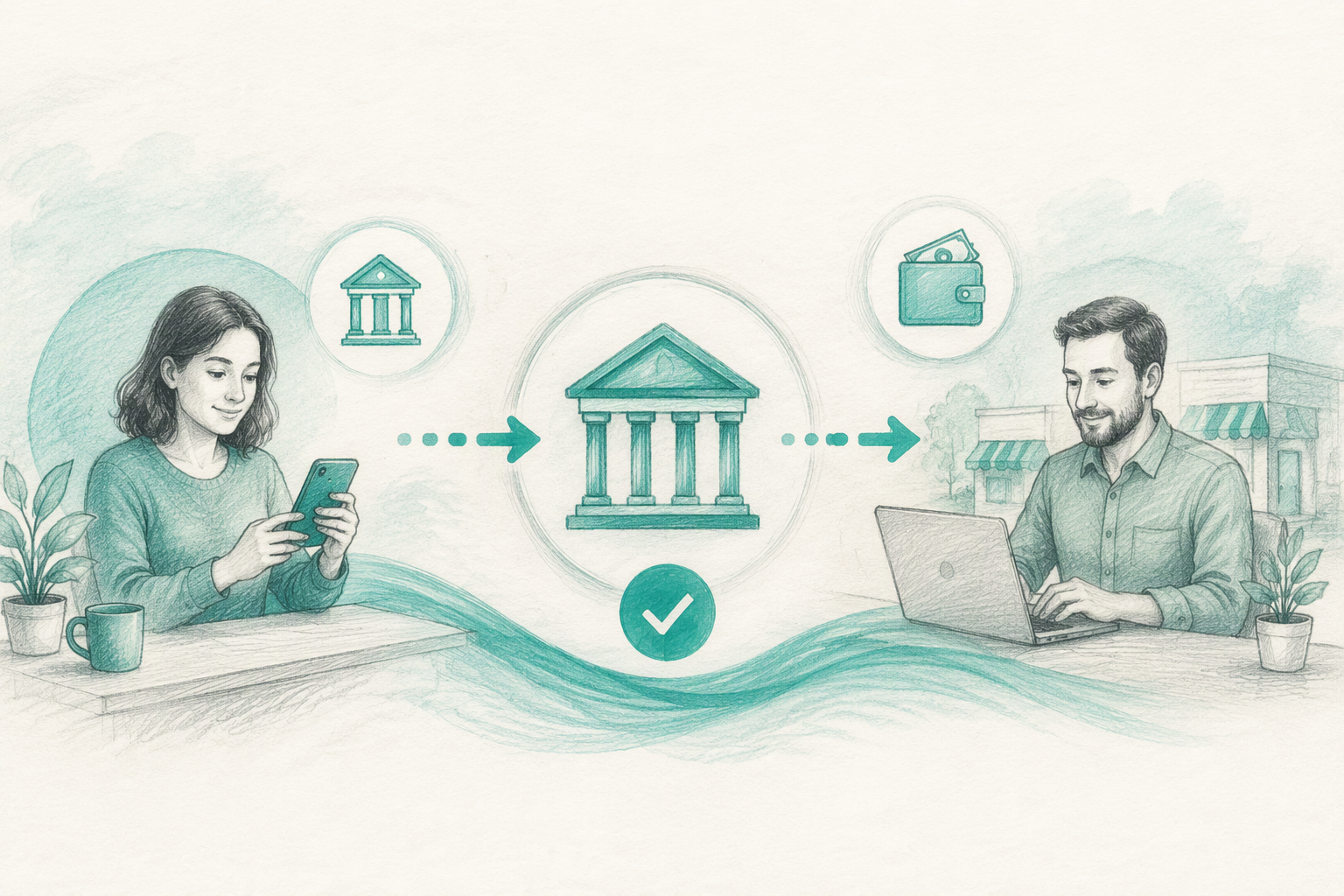
ACH is a type of bank transfer, but not every bank transfer is ACH. The Automated Clearing House is a US electronic network through which participating financial institutions exchange credit and debit entries between bank accounts.
Common uses include:
- Employee direct deposit
- Vendor and US contractor payments
- Rent collection
- Bill payments
- Subscription charges
- Recurring customer debits
The US Treasury describes ACH as a primary system for electronic funds transfers. Regulations and operating rules govern how financial institutions and Federal Reserve Banks clear and settle ACH entries.
ACH is primarily domestic infrastructure. It can form one part of a cross-border workflow, but it is not a complete international payroll solution.
The five parties in a typical ACH transaction
A typical ACH payment involves these roles:
- Originator: The person or business initiating the entry.
- Originating depository financial institution: The originator’s bank, often called the ODFI.
- ACH operator: The organization processing entries between institutions.
- Receiving depository financial institution: The recipient’s bank, often called the RDFI.
- Receiver: The employee, vendor, tenant, customer, or other account holder.
Payroll platforms and payment processors may sit between a business and its bank. They simplify file creation, approvals, funding, and reconciliation, but the underlying roles still exist.
What ACH does—and does not do
ACH transports payment instructions and funds. It does not classify workers, calculate payroll taxes, create compliant pay statements, register an employer, or determine whether a payment meets local payday rules.
That distinction matters. A banking dashboard may show a completed transfer even when the underlying payroll is incorrect. Payment rails and payroll compliance systems solve different problems.
How ACH payments move after approval
Suppose a startup approves Friday payroll on Wednesday. Its provider creates ACH entries, submits a batch through the originating bank, and sends it to an ACH operator. The operator routes each entry to the relevant receiving bank for settlement and posting.
Delays can result from missed cutoffs, late funding, invalid account information, risk reviews, bank policies, or returned entries. A batch marked “sent” is not necessarily money an employee can use.
Authorization and payment instructions
An ACH credit begins with the sender approving a payment. An ACH debit requires authority to pull funds from the payer’s account. The ACH file contains information such as routing numbers, account numbers, amounts, and payment dates.
Approval confirms permission to release the transaction. It does not confirm that the receiving bank has posted it or made the funds available.
Batching, clearing, settlement, and posting
ACH is designed to process batches containing multiple transactions. Clearing determines where entries should go, while settlement accounts for movement between participating financial institutions. The receiving bank then posts the entry to its customer’s account.
These events are connected, but they are not identical.
What each ACH status means operationally
Dashboard labels vary, so we recommend confirming each provider’s definitions:
- Initiated: Instructions were created.
- Pending or processing: The payment is not complete.
- Settled: Interbank settlement occurred, although posting may remain.
- Posted: The receiving bank applied the entry to the account.
- Returned: The bank sent the entry back.
- Reversed: A correction was submitted for an eligible error.
Do not mark payroll, rent, or an invoice as resolved merely because a batch was submitted.
ACH credit vs. ACH debit

An ACH credit pushes money from the sender’s account. An ACH debit pulls money from a payer’s account after authorization.
Credits depend on correct recipient details and sufficient sender funding. Debits add consent, revocation, recordkeeping, and dispute considerations.
ACH credit examples: Payroll and vendor payments
With direct deposit, an employer approves payroll and originates credits to employee bank accounts. “Direct deposit” describes the use case; ACH is commonly the network carrying it.
Vendor and contractor payments can work similarly. However, an ACH record does not prove that a contractor was classified correctly or that reporting duties were met. Founders comparing providers should also understand direct deposit and international limitations.
ACH debit examples: Rent and recurring billing
A property manager may collect recurring rent by ACH debit after obtaining authorization. We recommend retaining the authorization, relevant notices, revocation records, and evidence linking consent to the account and payment schedule.
A lease may permit rent collection without clearly documenting ACH debit consent. Separate, retrievable authorization provides better evidence if a debit is disputed.
How to choose between push and pull payments
Compare:
- Who initiates the payment
- When funding becomes visible
- Who manages returns
- What authorization is required
- How reconciliation works
- What happens when account details change
Before automating either method, we recommend assigning an approval owner, exception owner, and replacement-payment process.
ACH vs. wire, card, check, Zelle, RTP, and FedNow
“Bank transfer” is too vague for payroll operations. ACH, wires, RTP, FedNow, Zelle, checks, and cards follow different processes for timing, availability, cost, disputes, and failed payments.
Name the actual rail before promising when money will arrive.
ACH versus wire transfer
ACH commonly uses scheduled, batch-based processing. Wires may suit urgent or high-value exceptions where speed and delivery certainty justify the added cost.
Wires also carry fraud and recall risks. We recommend independently verifying changed banking instructions before releasing either an ACH payment or a wire.
ACH versus cards, checks, and Zelle
Cards can provide immediate authorization but involve processing fees and chargeback exposure. Checks add printing, mailing, loss, deposit, and reconciliation risks.
Zelle has separate enrollment requirements, limits, rules, and user workflows. It should not be treated as interchangeable with ACH. Consumer payment apps are also poor substitutes for documented payroll processes.
ACH versus RTP and FedNow
RTP and FedNow are separate payment systems that may support faster transfers when the relevant institutions and payment are eligible. They can be useful for time-sensitive exceptions, but availability must be confirmed.
Faster movement leaves less time to catch errors. Account verification, treasury approvals, fraud controls, payroll calculations, and wage-payment compliance still apply.
How long does ACH take? Standard vs. same-day ACH
ACH timing depends on the full processing chain: provider cutoff, approval, funding, bank submission, settlement, receiving-bank posting, and recipient availability.
Standard and same-day services use different schedules, but neither creates one universal arrival time. Holidays, weekends, reviews, funding requirements, late submissions, and bank policies can affect delivery. Same-day ACH does not mean instant.
Why published cutoff times may not be your cutoff
A network processing window may differ from the deadline set by a payroll provider or originating bank. Providers may require earlier approval or funding to review and submit a file.
Before payroll, confirm:
- The provider’s operating timezone
- Approval and funding deadlines
- Holiday handling
- Same-day eligibility
- Procedures for a missed cutoff
Settlement is not always account availability
Settlement does not always mean an employee can spend the money. The receiving bank still controls posting and may conduct its own review.
For time-sensitive payroll, track recipient availability and exceptions. A settlement report alone may not show that every worker received usable funds.
A payroll timing checklist
Count backward from the required payday and include:
- Payroll approval
- Funding time
- Provider and bank cutoffs
- Banking holidays
- Error-correction time
- Return monitoring
- Replacement-payment time
We treat same-day ACH as a planned service option, not a substitute for reliable payroll controls.
ACH fees and the real cost of a failed payment
ACH pricing may be per transaction, per batch, monthly, percentage-based, or bundled into a banking or payroll plan. There is no universal fee because pricing varies by institution, provider, entry type, volume, and service level.
A low transaction price can become expensive when a return creates investigation, support, reconciliation, and replacement-payment work.
Direct fees to confirm before a large batch
Ask about:
- Origination and same-day charges
- Batch or monthly platform fees
- Account-validation costs
- Return and reversal fees
- Retry charges
- Expedited support
Also confirm whether fees apply when entries are submitted, settled, failed, retried, or returned.
Hidden costs founders should model
Operational costs can include worker downtime, lost trust, support tickets, treasury effort, late-payment exposure, duplicate payments, and foreign-exchange costs.
We recommend measuring the cost of accurate, successful, on-time delivery—not only the fee for submitting an entry.
ACH returns, reversals, and failed payroll
An ACH return occurs when a receiving institution sends an entry back. Causes may include insufficient funds, closed accounts, invalid details, stopped payments, unauthorized debits, or administrative errors.
A reversal is different. It is a correction mechanism for certain erroneous entries, not a general recall button.
Common return-code categories and the right response
Respond according to the issue:
- Funding problem: Review whether a retry is permitted and appropriate.
- Invalid account data: Obtain verified replacement instructions.
- Closed or restricted account: Contact the recipient.
- Authorization dispute: Stop automatic retries and retrieve consent records.
- Processing error: Escalate and reconcile all affected entries.
Retry requirements depend on the return reason, provider policy, network rules, and applicable law.
When not to retry an ACH payment
Do not blindly retry entries involving invalid details, closed accounts, revoked authorization, or an unauthorized-debit claim. Repeated attempts can create extra fees, duplicate payments, or further disputes.
Our preferred approach is a documented retry policy with approval requirements and duplicate-payment checks.
Failed-payroll response plan
When payroll fails:
- Identify affected workers.
- Preserve the original entry and return records.
- Confirm the failure reason.
- Verify corrected payment details.
- Choose an acceptable replacement method.
- Give workers a clear update.
- Reconcile the replacement against the return.
Move quickly, but verify the replacement before sending it.
ACH authorization, security, and fraud controls
ACH controls should prevent both fraud and ordinary mistakes. A trusted employee can still upload an old file, edit the wrong account, or release a batch twice.
Requirements vary by transaction type, channel, account, bank agreement, network rule, and applicable law.
Operational proof of consent for rent and recurring debits
For recurring debits, retain records covering the payer, account, amount or calculation method, frequency, start date, revocation method, authorization date, and later changes.
Store evidence where the operations team can retrieve it. Broad contract language may not clearly establish payment authorization.
Controls before releasing an ACH batch
Useful controls include maker-checker approval, role-based permissions, bank-detail verification, duplicate-file detection, exposure limits, and separate confirmation for sensitive updates.
Where practical, separate the ability to create payees, edit accounts, approve batches, and release funds.
Daily reconciliation and exception monitoring
Match submitted totals against settlement records, bank activity, returns, reversals, and worker-level payroll records. Assign each exception to an owner and deadline.
An unread return in a dashboard is still an unresolved payment.
ACH for payroll: Moving money is not payroll compliance
ACH can deliver net pay. It cannot determine worker status, calculate gross-to-net wages, withhold taxes, apply statutory deductions, create pay statements, or complete employer registrations.
Employee payroll and contractor accounts payable remain distinct workflows even when both end with an ACH credit.
Preflight checklist for an ACH payroll batch
Before release, confirm:
- Worker classification and status
- Approved payroll calculations
- Verified account changes
- Available funding
- Provider cutoff and payday
- Batch total and employee count
- Appropriate approval
- Exception owner and replacement options
Link payment confirmation to payroll records instead of treating a bank export as the complete payroll file.
Employee consent, pay statements, and wage timing
Direct-deposit consent and permitted wage-payment methods vary by jurisdiction. Payroll should be designed around the required payday, not an estimated bank settlement date.
Retain payment records alongside pay statements, deductions, withholding, filings, and correction history.
US ACH versus international payroll
ACH is suitable for eligible US accounts. Workers abroad generally need supported local or cross-border payment methods, as well as country-specific tax, classification, currency, benefits, and payroll processes.
Our guide to paying international contractors explains why the payout method is only one decision. An international payroll platform built for founders can coordinate compliant calculations and local delivery without treating US ACH as global infrastructure.
Run payroll without treating ACH as the whole solution
ACH is a useful US payment rail, but international teams also need compliant calculations, suitable local payout methods, and reliable exception handling. Explore Shor to coordinate international payroll and worker payments without forcing domestic payment infrastructure to solve global employment problems.
FAQ
What is an ACH payment?
An ACH payment is an electronic credit or debit exchanged between participating US financial institutions. Common uses include payroll direct deposit, vendor payments, rent debits, and recurring bills.
What is the difference between ACH and a bank transfer?
ACH is one type of bank transfer. Wires, RTP, FedNow, Zelle, and international local transfers use different operating models. Identifying the actual rail helps us assess timing, cost, availability, and failure handling.
Is Zelle an ACH transfer?
Zelle and ACH are distinct services with different enrollment, limits, timing, and operating procedures. They should not be treated as interchangeable payment methods.
Does ACH work internationally?
ACH is primarily US payment infrastructure, not a global payroll network. A provider may use ACH to fund part of an international payment workflow, but cross-border payroll usually requires additional currency, tax, classification, and local-payment support.
What does the German word “ach” mean?
The German word “ach” is an interjection similar to “oh,” “ah,” or “alas,” depending on context. It is unrelated to the Automated Clearing House.
Does ACh also mean acetylcholine?
Yes. In medicine and physiology, “ACh” can abbreviate acetylcholine. In banking, payroll, and payment operations, ACH usually refers to the Automated Clearing House.